

THE Triangle
Are you the Victim, Villain, or Victor? How to recognize—and escape—The Triangle.

Updated 2/14/26 - Originally published Dec 15, 2023
A note before you read: I originally wrote this blog in the process of integrating a Bufo ceremony in Cancun. I was teaching what I’d just learned, convinced I’d figured it out. Since then, I’ve spent years actively living inside The Triangle - playing Victor with my partner, Villain with my mother, learning these patterns in my bones instead of just my brain. I’m using AI to help me rewrite this piece, not to make it perfect, but to show evidence of growth. This is what integration actually looks like: returning to your own teaching and admitting you’re still learning the lesson.
The Lie That Revealed the Truth
In Cancun, Mexico, I sat across from a crack pipe filled with Bufo alvarius — 5-MeO-DMT, also called Toad Medicine. My mind cycled through worst-case scenarios: What if this promised enlightenment was actually the doorway to addiction? What if I couldn’t come back?
I watched two people go before me. Then I inhaled.
The first round dissolved me into pure love — an emotional feast, the kind of bliss that makes you understand why people chase mystical experiences. But the second round? That cracked me open in a different way. Red-hot rage poured through me — ancestral and immediate — all of it aimed at a relationship I’d been refusing to look at clearly.
When the Medicine released me back into my body, I didn’t feel peaceful. I felt exposed. The rage had shown me something I’d been refusing to see: my role in a relational dynamic I’d been playing my entire life.
What the medicine revealed was a pattern I’d been unconsciously running for decades. I’d been cycling through three roles — sometimes Victim, sometimes Villain, sometimes Victor — convinced I was the exception to the dynamic I was actively creating.
That’s when I understood I was living in something my mentor Tah called The Triangle.
What Is The Triangle?
The Triangle has many names: Karpman Drama Triangle, Oppression Trap Triangle, relationship triad. At its core, The Triangle is a method of relating that takes you out of your power. It’s created through oppression.
Oppression, for our purposes, means the condition of opposing pressure. There are three primary types:
Three Types of Oppression
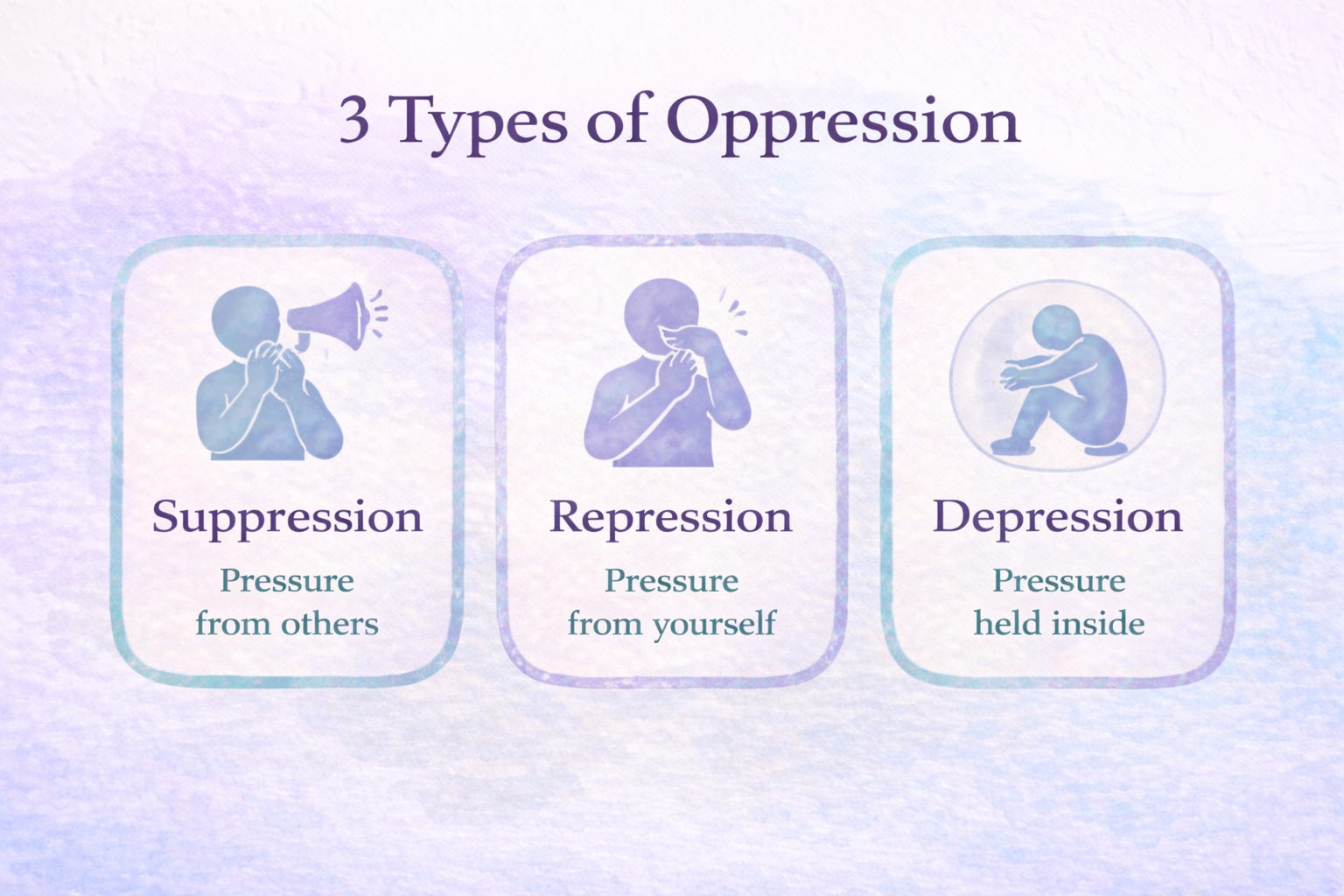
Suppression - Pressure created by something being held down. This occurs when someone or a group tells you what you can or cannot say. The direction of pressure is coming from another person. You might perceive yourself as the victim because, without your voice, you feel powerless.
Repression - Pressure created when you decide to hold something back. It’s no longer someone else telling you what you can or cannot say; it’s you choosing to hold back even though your gut may be screaming otherwise. The pressure direction comes from you responding to another person or group’s presence. You might perceive yourself as the villain because you believe what you say will hurt others, or even hurt you, meaning you can be both a victim and your own villain.
Depression - A holding in. Often described as anger turned inward. When suppression or repression goes to the next level, you land here. The pressure is inside you, but instead of wanting to come out like in repression, it stays inside, pushing against you. What can bring you out of this is a form of ‘saving’ - but know only you can save yourself. The desperate need for rescue gets externalized, and suddenly the victim has created the need for the hero, a slot many of us love the feeling of.
Food for Thought:
Where have you wanted to speak up but didn’t?
Where did you say something and someone told you it wasn’t important?
When have you become a lesser version of yourself because you internalized the pressure from the outside world?
How did these situations make you feel? Helpless, angry, sad, powerless? Those feelings are your body telling you you’ve entered The Triangle.
The question is: Do you know you created it?
The Triangle Has 3 Basic Roles
So let’s add some texture and definition to the Roles.
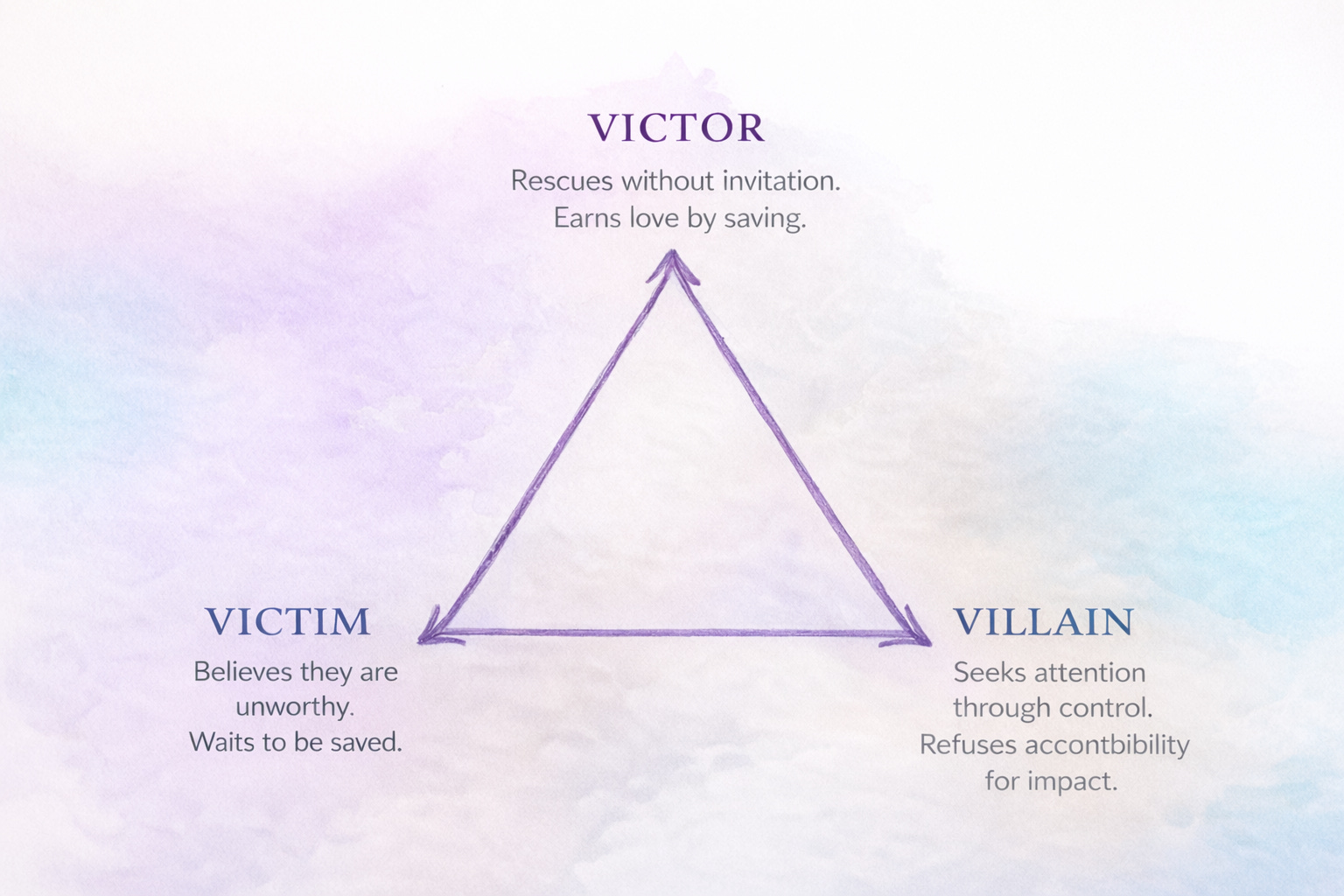
VICTIM
Oppressed or perceives being oppressed by Villain. Believes they’re unworthy of love and acts incapable to lure Victor in to save them. Acts without responsibility for the situation. Projects shame inward and outward.
VILLAIN
Oppresses the Victim or is perceived by the Victim as oppressive. Doesn’t seek love; instead, seeks attention. Also acts without responsibility for the situation.
VICTOR (HERO)
Rescues Victim with or without invitation/consent AND oppresses the Villain. Also believes they’re unworthy of love and instead believes they earn it by saving the Victim. Projects shame.
Why The Triangle Is Inherently Disempowering
One thing I notice with clients - and in myself - is how often we’re unaware of our role in creating The Triangle.
Being in The Triangle limits personal agency:
The Victim adopts learned helplessness, depends on external people/places/conditions to solve their problems, and surrenders control to external influences. This role doesn’t try to exert effort to create a way out - it relies on the Victor to stop the Villain.
The Villain fosters reliance on manipulative tactics for control, undermines genuine communication, and hinders authentic, empathetic connections. This provides short-term satisfaction but restricts the ability to foster meaningful, long-term relationships.
The Victor connects feeling strong with helping others, which is exhausting. Trying to rescue others might unintentionally ignore their choices, making it harder to have cooperative, equally empowering relationships.
The Triangle also creates co-dependency - when our state of being depends on another person, place, condition, or thing. The Victim is happy when the Victor defeats the Villain. The Villain is happy as long as the Victim is oppressed. The Victor is happy as long as there’s a Victim to save.
All of this externalizes your state of being. It’s not conducive to embodying your inner wisdom. But with enough observation, it might help you remember your power as Creator.
Shifting OUT OF THE TRIANGLE
A basic principle I live by: The outer world mirrors your inner world. When you see the same relationship dynamics pop up over and over, it’s an invitation to look inward and question what beliefs are no longer serving you.
These repetitious dynamics are here to teach you something. Are you learning the lesson? Likely not if you keep noticing the same roles showing up in your life time and time again.
Step 1: Become Aware
Notice when you’re in The Triangle:
Victim: Do you see the world as out to get you, and you can’t do anything about it?
Villain: Do you find yourself being the “bad guy” in everyone’s story or incapable of doing good?
Victor: Do you keep seeing people who need saving?
Step 2: Notice Your Primary Role
Which role do you gravitate toward most often? Get curious about what benefits you receive from being in that role.
Being the Victim can make you feel cared for, get attention/help from others, give you a break from responsibilities. It helps you see problems as coming from outside yourself - not your fault.
Being the Villain can make you feel powerful and important because you’re in control. It gets attention and makes you feel noticed.
Being the Victor can make you feel good because you help others and get attention for it. It gives you purpose and makes you feel important to those you rescue.
What if you enjoy two or even all three roles? Determine patterns. Maybe you play Villain in romantic relationships but Victim with your parents and Victor in your friendships. This allows you to focus on one role at a time, creating less overwhelm.
Step 3: Accept Without Judgment
Don’t judge yourself for receiving and enjoying the benefits of any role. Accept that it happened.
Kundalini and Tantra, of which I guide people in both, has really helped me with Witness Consciousness, slowling down enough to see things real time, and evolve over time toward my goals and dreams. A benefit of getting out of the triangle.
By our very nature, we are creators. Consciously or subconsciously, you’ve called these situations in to teach you something. As you learn the lesson, these dynamics will fade from your life.
Our inner world is shaped by core beliefs, some of which are limiting. When your outer world produces limiting situations like The Triangle, accept that they exist because of you. This allows you to step into a more empowered state of being.
How Each Role Steps Into Empowerment
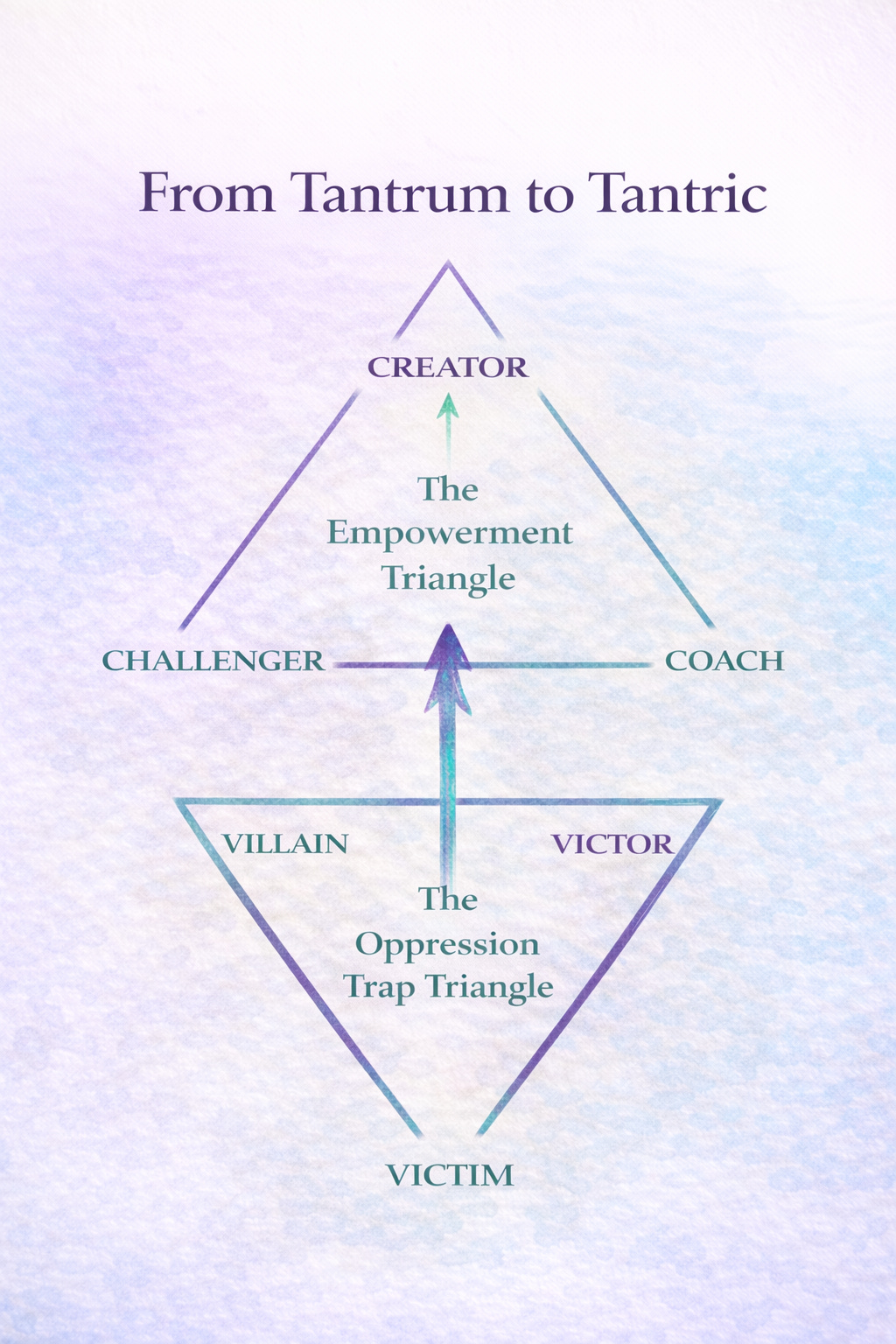
VICTIMS → CREATORS
Create solutions to the problem (the oppression). Brainstorm as many solutions as possible focused on what YOU can do, not what others need to do. This is about sovereignty, not outsourcing your saving to a Victor.
Mantra: “I’m solving this.”
Skills to develop: Problem-solving, self-awareness, boundary creation.
VILLAINS → CHALLENGERS
Create structure. State your boundaries in response to the Victim and stick to them. Make expectations clear. Create choices so the Victim can co-create a solution to the problem.
Mantra: “We’re solving this together.”
Skills to develop: Co-creating structure with the Victim, cultivating empathy, and fostering self-reflection about motivations for control and attention.
VICTORS → COACHES
Listen to the Victim and provide support only when asked.
Mantra: “I’m exploring along with you.”
Skills to develop: Recognizing limitations and creating boundaries to avoid the burden of rescues, seeing Victims as already empowered Creators not needing to be saved, building relationships on mutual support.
Your Own Personal Deep Dive
Before you scroll further, sit with these:
Victim Role: Have you noticed instances in your life where you’ve felt helpless or portrayed yourself as a victim? What were the circumstances, and how did you respond?
Villain Role: When have you found yourself acting in a way that others may have perceived as oppressive or controlling? What motivations or emotions were behind those actions?
Victor Role: Reflect on instances where you might have unintentionally disregarded others’ choices in your efforts to help. How did this impact the dynamics of the relationship?
Identifying Patterns: Are there recurring relationship dynamics in your life that resemble The Triangle roles? What patterns do you notice, and how do they manifest?
Personal Empowerment: Think about moments when you’ve taken charge of a challenging situation instead of adopting a victim mindset. How did this shift in perspective impact your experience?
Externalizing: How often do you find yourself externalizing your state of being, relying on external factors for happiness or resolution?
Moving Forward: Imagine stepping out of The Triangle entirely. What steps can you take to break free from limiting roles and embrace a more empowering and authentic way of relating?
I’ve given you the map. But maps don’t mean much until you see someone actually lost in the territory.
Below the fold, I show you exactly where I got lost — inside my own family system, playing all three roles across different relationships, convinced I’d figured it out while actively living proof I hadn’t. If you want the real version, not the cleaned-up teaching version, that’s what paid is for.
